
Blog
Reading Glasses Strength Chart by Age: What Strength Do You Need?


If you have started holding your phone at arm’s length or turning on every lamp in the house to read a menu, you are not alone. Almost everyone needs a little help with close-up vision sometime after 40. The good news is that over-the-counter readers are an easy, affordable fix. The tricky part is knowing which number to buy. This guide walks you through a reading glasses strength chart by age, a simple at-home test you can do in five minutes, and the signs that tell you it is time to see an eye doctor instead.
By the end, you will know exactly what strength reading glasses you need, how to pick the right style for your day, and how to avoid the most common mistakes people make with their first pair.
Why Your Close-Up Vision Changes After 40
The lens inside your eye is naturally flexible. When you look at something close, tiny muscles change its shape so the image stays sharp. Over the years, that lens slowly stiffens. Somewhere in your early to mid-40s it can no longer flex enough to focus on small print at a normal reading distance. Eye care professionals call this presbyopia, and it is a normal part of aging, not a disease.
Presbyopia usually shows up in small, everyday moments:
- You hold books, receipts, or your phone farther away to make the words clear.
- Small print looks fine in bright daylight but blurry in a dim restaurant.
- Your eyes feel tired or you get a mild headache after reading or sewing.
- You find yourself increasing the font size on every screen you own.
Because the lens keeps stiffening gradually, most people move up in strength every few years until their mid-60s, when the change tends to level off. That is why age is such a useful starting point when you choose a strength.
Reading Glasses Strength Chart by Age
Reading glasses are measured in diopters, written with a plus sign: +1.00, +1.25, +1.50 and so on, usually in steps of 0.25. The higher the number, the stronger the magnification. The chart below shows the strengths people most often start with at each age. Treat it as a starting point, not a prescription, since your eyes, your arm length, and the way you read all play a part.
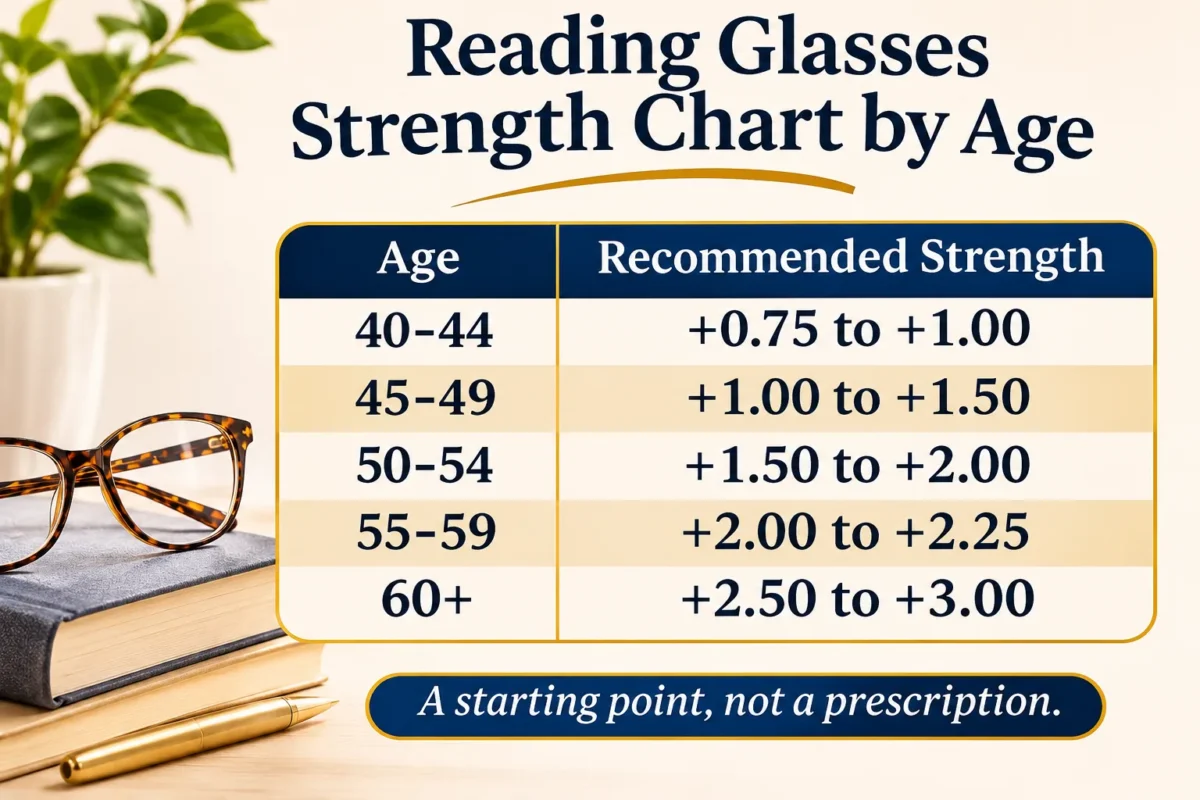
| Age | Typical starting strength | What it usually feels like |
|---|---|---|
| 40 to 44 | +0.75 to +1.00 | Small print is a little soft, especially in low light. |
| 45 to 49 | +1.00 to +1.50 | You start holding your phone and menus farther away. |
| 50 to 54 | +1.50 to +2.00 | Reading without glasses feels like real effort. |
| 55 to 59 | +2.00 to +2.25 | Most small print is hard to read at any distance. |
| 60 and up | +2.50 to +3.00 | Readers become part of every close-up task. |
A few things can shift you up or down this chart. If you are slightly farsighted, you may need a stronger pair earlier. If you are mildly nearsighted, you may need a weaker pair, or none at all, for reading. And if you do close work at a longer distance, such as reading sheet music on a stand, you will usually want a slightly lower number than you would for a paperback.
What Strength Reading Glasses Do I Need? A Simple At-Home Test
The most reliable way to answer “what strength reading glasses do I need” is a comprehensive eye exam. But if you want a quick check before buying over-the-counter readers, this simple test works well for most people.

Step 1: Find your comfortable reading distance
Sit where you normally read, with good light. Hold a book, magazine, or your phone at the distance that feels natural for your arms and posture. For most adults, that is about 14 to 16 inches from the eyes.
Step 2: Use small, everyday print
Choose text similar to what you read every day: a paperback page, a recipe card, or the ingredient list on a cereal box. Avoid headlines, since they are too large to reveal the problem.
Step 3: Start low and work up
Try the lowest strength in the chart for your age first. If the words are crisp and you can read for a minute without squinting, that is your number. If the print still looks soft, move up one step (+0.25) and try again. Stop at the lowest strength that makes the text clear and comfortable.
Step 4: Check the range
With the glasses on, slowly move the text closer and farther. A good match lets you read clearly across a small range around your usual distance. If you have to bring everything very close to see it sharply, the pair is too strong. If you have to push things away, it is too weak.
Tip: When you are between two strengths, choose the lower one. Readers that are too strong can make your eyes work harder, shrink your clear reading zone, and leave you feeling dizzy when you look up.
Matching Strength to the Way You Actually Read
The same person often needs slightly different help for different tasks. Think about where you spend most of your close-up time:
- Books, phones, and fine print (14 to 16 inches): Use the strength from your at-home test.
- Computer screens (20 to 26 inches): Many people are most comfortable about 0.50 to 0.75 lower than their book strength, because screens sit farther away.
- Crafts, sewing, and detail work (10 to 12 inches): Some people prefer a quarter or half step stronger for very close tasks.
If you spend hours at a laptop, a dedicated pair of reading glasses with a blue light filter in a slightly lower strength can make long screen sessions feel much easier. A filter can cut screen glare and some blue-violet light, though it does not replace good habits like regular breaks.
Single Vision, Bifocal, or Progressive Readers?
Once you know your number, the next choice is the lens style. Each one solves a different problem.

Single vision readers
The whole lens has the same magnification. They are ideal for sitting down with a book or a crossword, and they are the most affordable option. The catch is that distance vision looks blurry through them, so you will take them on and off when you look up. If you like having spares in the kitchen, car, and nightstand, multi-packs of quality non prescription reading glasses make that easy.
Bifocal readers
Bifocal readers have a clear top section with no magnification and a reading section at the bottom. You can glance up across the room, then look down to read, without taking your glasses off. They are a favorite for meetings, shopping lists, and cooking. Browse our bifocal reading glasses clear on top if you are tired of the on-and-off routine.
Progressive (multifocus) readers
Progressive readers blend from clear at the top to full reading strength at the bottom, with an intermediate zone in between that suits computer screens and dashboards. There is no visible line, so they look like regular glasses. Most people need a day or two to get used to moving their chin slightly to find the sweet spot. See our progressive reading glasses clear on top for no-line options.
Choosing Frames That Fit Your Face and Your Style
The right strength matters most, but the right frame decides whether you actually wear your glasses. A few quick guidelines help:
- Width: The frame should be about as wide as your face at the temples, without pinching or sliding.
- Bridge fit: The glasses should sit level and stay put when you look down at a book.
- Lens height: Bifocal and progressive readers need a slightly taller lens so there is room for every zone.
- Face shape: Cat eye and soft rectangular frames flatter round faces, while rounder frames soften angular features.
Readers no longer need to look like a drugstore afterthought. Cat eye, half moon, oversized, and slim styles let you match your glasses to your outfit or your mood. Our collection of stylish reading glasses for women includes options like cat eye reading glasses for women and reading glasses for small faces, so you can find a fit that feels made for you.
Common Mistakes When Buying Your First Pair
Most problems with over-the-counter readers come from a handful of easy-to-avoid mistakes:
- Buying the strongest pair “just in case.” Too much magnification shrinks your focus zone and can cause eye strain. Pick the lowest strength that works.
- Using one pair for everything. A book-strength pair can feel wrong at the computer. Two pairs in different strengths often solve this.
- Testing in perfect light only. Try your readers in the lighting where you will actually use them, including evenings.
- Ignoring comfort. Frames that pinch or slide will end up in a drawer. Fit matters as much as strength.
- Skipping the eye exam for years. Readers help with focus, but they do not check the health of your eyes.
When to See an Eye Doctor Instead
Over-the-counter readers are designed for people whose only issue is close-up focus, with similar vision in both eyes. They are not a substitute for professional care. Book an exam with an optometrist or ophthalmologist if you notice any of the following:
- You need different strengths for your left and right eye.
- You have astigmatism, or straight lines look wavy or distorted.
- Your distance vision is also blurry.
- You see flashes, floaters, halos, or a curtain over part of your vision.
- Vision changes suddenly, or you have eye pain, redness, or frequent headaches.
- You need more than +3.00 to read comfortably, or your strength jumps quickly.
Most eye care organizations recommend regular comprehensive eye exams for adults over 40, even if you feel your vision is fine. Your doctor can confirm your reading strength and check for conditions that often have no early symptoms.
How Often Should You Update Your Readers?
Because the eye’s lens keeps changing, many people move up about one step (+0.25 to +0.50) every two to three years until their mid-60s. Signs it is time for a stronger pair include holding things farther away again, needing brighter light, or feeling tired after short reading sessions. Keep your old pair, though. A lower strength often works perfectly at the computer.
Caring for Your Reading Glasses
- Clean lenses with lukewarm water, a drop of mild dish soap, and a microfiber cloth. Avoid paper towels and your shirt, which can scratch coatings.
- Store them in a case when you are not wearing them, and never place them lens-down.
- Do not leave them on a car dashboard, where heat can warp frames and damage coatings.
- Keep a pair everywhere you read: nightstand, kitchen, desk, and bag. Multi-packs make this affordable.
Frequently Asked Questions
What strength reading glasses should I start with?
Most people in their early 40s start with +0.75 to +1.00. Use the chart by age as a starting point, then do the at-home test and choose the lowest strength that makes small print clear at your normal reading distance.
Is it bad to wear reading glasses that are too strong?
Readers that are too strong will not damage your eyes, but they can cause eye strain, headaches, and a narrow focus zone. If you have to hold text very close to see it clearly, try one step lower.
Can I wear reading glasses all day?
You can wear them for as long as you are doing close-up tasks. Single vision readers will blur distance vision, so take them off to walk around or drive. Bifocal and progressive readers let you see near and far without switching.
Do reading glasses make your eyes weaker?
No. Needing a stronger pair over time is caused by the natural aging of the eye’s lens, not by wearing readers. Glasses simply make close work more comfortable.
What is the difference between +1.50 and +2.00 reading glasses?
The number is the magnifying power in diopters. A +2.00 lens magnifies more than a +1.50 and is usually comfortable at a slightly closer reading distance. Pick the one that makes print clear at the distance you normally read.
Find Your Perfect Pair
Choosing reading glasses does not have to be confusing. Start with the reading glasses strength chart by age, confirm your number with the at-home test, and pick a lens style that matches your day: single vision for reading, bifocal or progressive for life on the go, and blue light readers for screen time. Then have fun with the frame.
Ready to see clearly in style? Shop all reading glasses at Cute Readers in strengths from +1.00 to +4.00, and keep a pair wherever you read.
This article is for general information only and is not medical advice. Always consult an eye care professional about changes in your vision.